
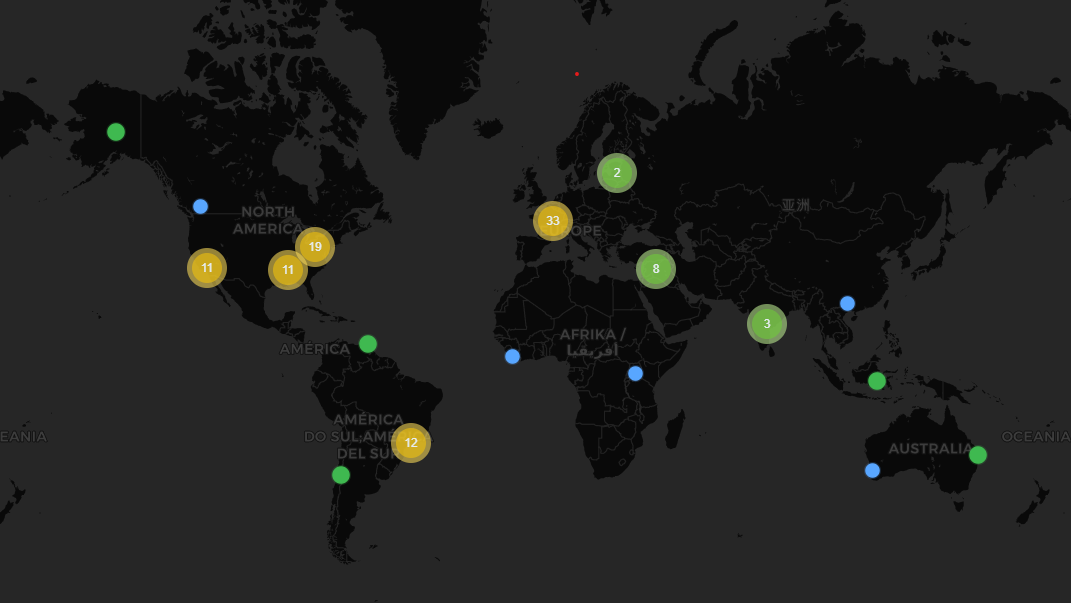
What if you could see where souls have traveled — across continents, across centuries — on a single interactive map?
We’re excited to share a new tool built by ILCS board advisor Chuck McMurray: the Reincarnation Case Map. It’s a free, open-access web app that plots over 320 reincarnation cases from the archives of Walter Semkiw and the broader research literature onto an interactive world map — making it possible, for the first time, to explore the geography of reincarnation research visually.
What the Map Does
The Reincarnation Case Map lets you browse documented reincarnation cases plotted on a globe. Each case is represented as a pin — color-coded by confidence level — and linked to its source material. The tool brings together cases spanning more than 5,000 years of human history, from ancient civilizations to modern-day figures.
Key features include:
- Interactive world map — Built on OpenStreetMap with Leaflet.js, cases are plotted by the geographic locations associated with past and present lives. Zoom in on regions to discover clusters of cases you might never have connected.
- Confidence-level filtering — Cases are color-coded by evidence strength: High (85%+), Medium (70–84%), Low (55–69%), and Very Low (<55%). This aligns with our commitment to transparent evidence labeling — you can see at a glance which cases rest on the strongest foundations.
- Timeline slider — Scrub across a timeline from 3000 BCE to 2025 CE and watch cases appear and disappear based on the historical periods involved. This is a powerful way to see how reincarnation research spans eras and cultures.
- Category filters — Sort cases by type, including childhood memory cases, celebrity and historical figure hypotheses, soul-group patterns, and more.
- Searchable case list — A scrollable sidebar lists all 320 cases alongside the map, making it easy to find a specific case and jump to its location on the globe.
- Proximity Analyzer — A unique tool that lets you explore geographic and temporal overlaps between two souls’ lifetimes.
Why Geography Matters in Reincarnation Research
One of Walter Semkiw’s 10 Principles of Reincarnation is Geographic and Cultural Pull — the observation that souls often show strong affinities for specific regions, sometimes returning to the same geographic area across lifetimes, and other times making dramatic cross-cultural shifts that challenge assumptions about national and ethnic identity.
Until now, this principle has been discussed case by case. The Reincarnation Case Map makes it possible to see geographic patterns across the entire archive at once. Are there clusters in certain regions? Do some souls travel vast distances between lives while others stay close to home? These are the kinds of questions the map invites you to explore.
What This Tool Is — and What It Is Not
The Reincarnation Case Map is an exploratory and educational tool. It is not a proof engine. The confidence ratings reflect the strength of available evidence using our published rubric, not a declaration of certainty. Cases sourced from intuitive or medium-based methods are included alongside empirically investigated cases — each labeled transparently so you can draw your own conclusions.
Some cases in the archive (93 of 320) do not yet have geographic coordinates assigned and appear in the case list but not on the map. This is an ongoing data project, and we welcome contributions from researchers and community members who can help fill in the gaps.
Built With Modern Tools, Grounded in Legacy Research
The app was built using React and TypeScript and is hosted on Replit. It draws on the case archive originally compiled by Walter Semkiw at ReincarnationResearch.com, now maintained and expanded by the Institute for Life Continuity Studies (ILCS).
This is one of several technology initiatives underway at ILCS as part of our broader vision for a Continuity Archive — a structured, searchable, evidence-labeled digital repository of reincarnation research that can serve scholars, experiencers, and curious minds alike.
How to Use the Reincarnation Case Map
The map is designed to be intuitive, but here’s a walkthrough of every control so you can get the most out of it.
The Map & Pins
- Colored pins represent individual cases, color-coded by confidence: 🟢 green = High (85%+), 🔵 blue = Medium (70–84%), 🟡 gold = Low (55–69%), ⚪ grey = Very Low (<55%).
- Numbered clusters (like 33 or 19) appear when multiple cases overlap geographically. Click a cluster to zoom in and see the individual pins.
- Click any pin to open a popup card showing the case title, confidence score, category tags, past-life and present-life locations and dates, a brief description, and a “Read full case →” link to the original article.
- Use the + / − buttons (top-left of map) or your scroll wheel to zoom. Click and drag to pan.
- Click Reset Map (top navigation) to return to the default global view.
The Case List (Left Sidebar)
- The sidebar labeled “Soul Journeys” lists all cases in a scrollable panel. Each entry shows the case title and number of lives recorded.
- Click any case in the list to select it. The map will zoom to that case’s location (if coordinates exist) and filter the view to show only that case.
- A “Clear Soul Journey” button appears at the top when a case is selected — click it to deselect and return to the full map.
- Use the collapse arrow (‹) on the right edge of the sidebar to hide the list and give yourself more map space. Click (›) to bring it back.
Search
- Click Search in the top navigation to open the search bar.
- Type a name, location, or keyword. Live suggestions appear as you type — select one and the map zooms directly to that case’s location.
- Click the ✕ to clear your search and return to the full view.
Timeline
- The timeline bar at the bottom spans 3000 BCE to 2025 CE.
- Instant mode (default): A single slider represents a point in time. The map shows only cases whose lifetimes overlap that moment. Drag the slider to travel through history.
- Window mode: Click “Window” to switch to a range slider with “From” and “To” handles. The map shows all cases that fall anywhere within your selected date range — useful for exploring a specific era.
- Press the ▶ Play button to animate the timeline forward automatically and watch cases appear and disappear across the centuries.
- The “Show unknown dates” checkbox (bottom-right) controls whether cases without known dates appear on the map. Uncheck it to see only date-verified cases.
Filters
- Confidence filters (bottom-right legend): Click any confidence level — High, Medium, Low, or Very Low — to toggle that tier on or off. This lets you isolate the strongest cases or explore the full range.
- Category filters (bottom of sidebar, scroll down): Check or uncheck categories like Military, Children, Celebrity, Birthmarks, Phobias, Same-Family, and Cross-Cultural to focus on specific case types. Use “Deselect all” or “Select all” to quickly adjust.
Proximity Analyzer
- Click Proximity Analyzer in the top navigation to open the analysis panel.
- Select two souls from the dropdown menus (Soul 1 and Soul 2).
- Set a distance (in kilometers, default 500) and a time window (in years, default 50).
- Click “Analyze Overlaps” to see whether the two souls’ lifetimes overlapped within the specified geographic and temporal range — a way to explore whether two souls may have crossed paths.
Try It Yourself
The Reincarnation Case Map is live and free to use at reincarnationmap.com.
We’d love to hear what patterns you notice. Do certain regions light up in ways you didn’t expect? Do the timeline patterns tell a story? Share your observations with us in the Reincarnation Forum or reach out through our Community page.
Investigation does not require certainty — but it benefits from good tools.
Scan QR Code to transfer to another device:




Leave a Reply