
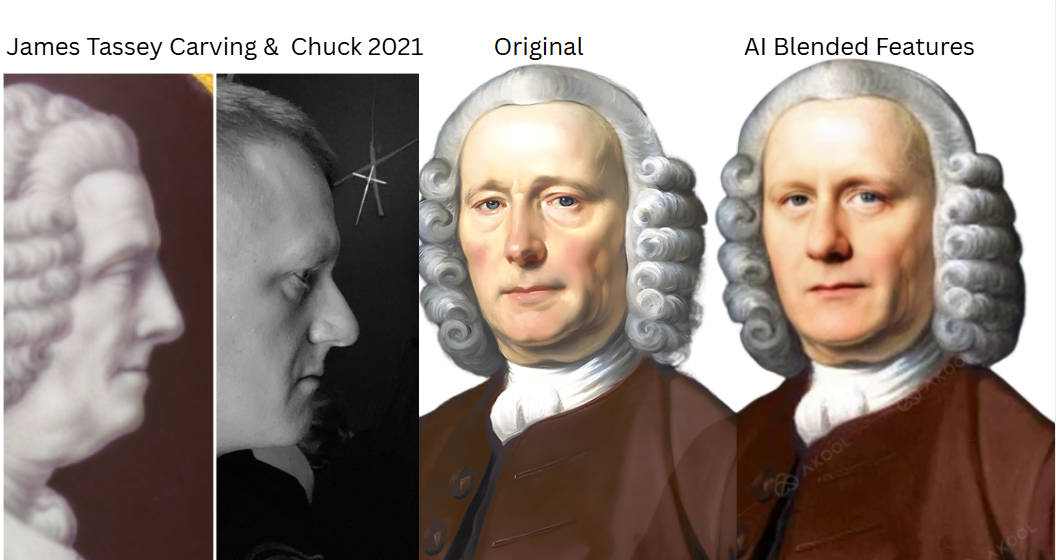
What do a clockmaker who stopped sailors from dying at sea and a software developer building AI research infrastructure have in common? Three pieces of evidence recorded in 2015 — and a name I never could have guessed.
Method Disclosure:
This case involves intuitive-track sourcing. Impressions in my 2015 regression session were facilitated by Kevin Ryerson, a professional spiritual intuitive whose work with researcher Walter Semkiw spans three decades. Per ILCS standards, intuitive-track content is exploratory and is never the sole basis for an identity claim. All evidence points in this post are labeled to distinguish documented historical record from personal impression. The proposed connection between myself and John Harrison remains a hypothesis under active research.
Here is a question worth sitting with: What if the things you are compelled to build — the problems you cannot stop trying to solve — are not entirely new? What if the drive is older than this lifetime?
That question is at the center of the case this post documents. And what makes it worth documenting is not the metaphysics. It is the timeline.
The Problem Harrison Solved — and Why It Still Matters
In the early eighteenth century, sailors were dying. Not from storms or pirates, but from a measurement problem. Without accurate longitude, ships wandered. Navigation was guesswork dressed up as confidence, and the sea punished the difference.
John Harrison, a self-taught Yorkshire clockmaker, spent the better part of his life solving this. His marine chronometer — a clock precise enough to hold Greenwich Mean Time through weeks of rolling ocean — made longitude calculable. When you know exactly what time it is at a fixed reference point, you can determine how far east or west you are. Harrison did not merely build a better clock. He made trust measurable. He built a standard that held steady while everything around it moved.
He called his life’s work, in essence, a war on drift.
The Regression That Happened First
In September 2015, I sat for a past-life regression session. At the time, I was a software developer, data strategist, and self-described builder rather than a mystic. I went in with no specific target and no knowledge of eighteenth-century English clockmakers. What emerged, in a facilitated session with intuitive Kevin Ryerson, was a set of sensory impressions that were logged and dated.
The impressions were specific. A workshop. An obsession with precision work in eighteenth-century England. The smell of sawdust and machine oil. And then, breaking through, something heavier: a devastating grief over a lost family. An older man waiting for a letter from a son. A name — William.
That is where the record sat for nearly three years. Documented. Undisturbed. Unexplained.
My regression was dated September 2015. The potential historical identification did not come until April 2018 — when I encountered a Google Doodle marking the 325th birthday of John Harrison, an English clockmaker I had never heard of. I felt an immediate sense of recognition that prompted me to investigate.
The significance of this gap is methodological. The specific details — Yorkshire, clockmaker, grief over family, the name William — were on record nearly three years before I had any access to the historical information that would confirm them. This temporal separation is what researchers call a cryptomnesia firewall: the documented impressions predate any possible exposure to the confirming material. It does not prove reincarnation, but it does substantially reduce the most common skeptical explanation.
When the Historical Record Answered Back
Once Harrison’s name was in play, the comparison between my 2015 impressions and the historical record could proceed. The results were difficult to dismiss.
Harrison was, in fact, a clockmaker in Yorkshire. He experienced real and documented grief: his first wife Elizabeth and their infant son both died. And his surviving son — the one who traveled with him, who tested the chronometers, who was present at the most critical moments of Harrison’s life — was named William.
The name William, drawn from my regression in 2015, matched the historical record I discovered in 2018.
Of all the details that emerged in the 2015 session, the name “William” carries the highest evidentiary weight. It is a specific, falsifiable claim: either Harrison had a son named William or he did not. Historical records confirm he did — a son who worked alongside him and whose collaboration on the H4 chronometer is well-documented. The probability of randomly selecting the correct name from the regression, years before knowing Harrison existed, suggests this is a detail worth taking seriously as an evidence anchor.
What AI Facial Recognition Found
As part of the case’s retro-matching analysis, an AI facial recognition tool was used to compare my face to available historical portraits of John Harrison. The tool returned a cosine similarity score of 0.87.

In facial recognition analysis, scores above 0.80 are typically characterized as highly probable matches — the range associated with identical twins or the same person photographed years apart. A score of 0.87 places the comparison between my face and Harrison’s in that high-confidence category. ILCS treats facial similarity as a supporting data point rather than a standalone claim. Physical resemblance is one indicator among several, not the foundation of the case. But in combination with the name match and the cryptomnesia firewall, it is a pattern that warrants continued investigation.
“Harrison didn’t just make a clock. He made trust measurable. And I realized how much of my life has been about the same thing: creating systems that people can rely on when their own instincts are unreliable.”
The Continuity of Function Thesis
What makes this case structurally interesting — beyond the individual evidence points — is the pattern it suggests across lifetimes. The argument is not that I am “claiming to be famous.” The argument is more precise than that: the same job function appears to repeat.
Harrison’s life work was stopping temporal drift. Sailors lost at sea died because measurement was unreliable. He solved it with a precision instrument that held a standard steady in chaotic conditions.
My life work, across technology, data systems, and now the Institute for Life Continuity Studies, is also about stopping drift — model drift, data drift, narrative drift, the drift of a field of inquiry that lacks structured methodology. The tools are different. The mission, if the continuity hypothesis holds, is consistent.
This is what ILCS calls the “continuity of function” thesis: that a soul may carry forward not a biography or a status, but a job. A recurring responsibility. The tools change with the era. The underlying problem being solved does not.
📚 Explore the Full Visual Case Study
The multi-life continuity thesis is presented in detail in Engineering Reincarnation: The War on Drift — a 14-slide visual dossier covering the blind regression evidence, facial architecture analysis, falsification protocol, and the 2,000-year chronometer thread from ancient Egypt to modern AI.
Download the presentation (PDF) →Three Principles the Evidence Touches
ILCS evaluates proposed reincarnation cases against a 10-point validation framework. Three of those principles are meaningfully engaged by this case:
AI facial similarity analysis yielded a 0.87 cosine similarity score between myself and portraits of John Harrison — a result in the high-confidence range by standard benchmarks. Physical resemblance is a supporting indicator, not a primary claim.
My lifelong preoccupation with precision, timing, systems, and the reduction of operational drift predates my knowledge of Harrison and cannot be attributed to imitation or cultural influence. The alignment between my present-life professional obsessions and Harrison’s core mission is consistent with the principle of carried-forward vocational orientation.
Both Harrison and I present as methodical, standards-driven, and resistant to drift — in technical systems and in our broader worldviews. Both exhibit what might be described as an inability to accept imprecision as inevitable. Personality continuity is assessed here as a supporting indicator, not independent proof.
Note: This post presents a partial view of the validation framework. The full 10-point matrix and evidence scorecard are available to Behind the Curtain subscribers.
How This Case Helped Fuel Energy at the Institute
When I began working through the evidence — the timeline, the name, the facial analysis, the functional parallel — I realized something crucial. There was an established methodology for investigating cases like this with rigor. Pioneers like Walter Semkiw, working alongside intuitives like Kevin Ryerson and others, had already perfected a disciplined practice. What was missing was the modern infrastructure to support and scale that work.
In my day job in corporate America, I design AI systems and software to organize and scale complex data. It only made sense to extend that learning to the tracking and finding of soul-related information. The field needed shared evidence rubrics, systematic ways to document impressions before exposure to confirming material, and frameworks to assign confidence tiers and publish findings in a way that invites scrutiny rather than deflecting it.
So, I built the systems to do exactly that.
To be clear, this case didn’t become the Institute for Life Continuity Studies (ILCS). ILCS is a collaborative effort, driven by a team of researchers who bring their own profound spiritual dimensions and unique magic to the work. I just happen to be the in-house technologist. But this case became the catalyst for the infrastructure I created to support that shared mission. Our founding premise is that if cases like this are worth investigating, the investigation deserves tools, structure, and transparency that match the seriousness of the question.

Harrison stopped navigational drift with a precision chronometer. I build the systems — structured evidence frameworks, tiered confidence labeling, and a growing archive — to help ILCS stop methodological drift in reincarnation research.
Same function. Different materials. 333 years apart.
Go Deeper on This Case
The full analysis of the McMurray–Harrison case is available to Behind the Curtain subscribers. That includes the complete 10-Principles matrix with confidence ratings for all ten dimensions, the evidence scorecard with A–F tier labels for every claim, an OCEAN personality overlay comparing the two subjects, and documented counterpoints (including the strongest skeptical arguments).